Want to know how to translate a YouTube recipe into English without guessing ingredients, cooking times, or auto-caption chaos? Some of the best cooking on YouTube is in languages you don’t speak.
Italian grandmothers making pasta by feel. Korean street food channels with millions of views. Japanese baking tutorials where the precision is almost meditative. French regional cooking that never made it onto an English-language food blog.
The food looks incredible, the comments are full of praise, and you’re ready to make it — until the recipe starts and you realise you can’t understand a word.
At that point, you’re stuck trying to decode auto-captions that turn a perfectly normal cooking instruction into something like “boil the happiness until aggressive.” Not ideal when you’re standing next to a hot pan.
Here’s a better way.
Why YouTube’s built-in translation isn’t enough to translate a YouTube recipe into English
YouTube can auto-generate captions and sometimes auto-translate them. For watching a documentary or following a conversation, that’s often fine.
For cooking, it usually isn’t — and YouTube recipes are already hard enough to follow even in your own language.
The problem is that cooking videos rely heavily on precise language: exact quantities, technique verbs, ingredient names that don’t map cleanly across languages. Auto-translation struggles with all of these.
You might get a subtitle that says “add a large portion” when the spoken amount was “2 tablespoons.” Or an ingredient name that gets transliterated rather than translated, leaving you searching for something that doesn’t exist under that name in your country. Or captions that skip sections entirely because the creator spoke too quickly.
Subtitles are built for watching. They’re not built for cooking from.
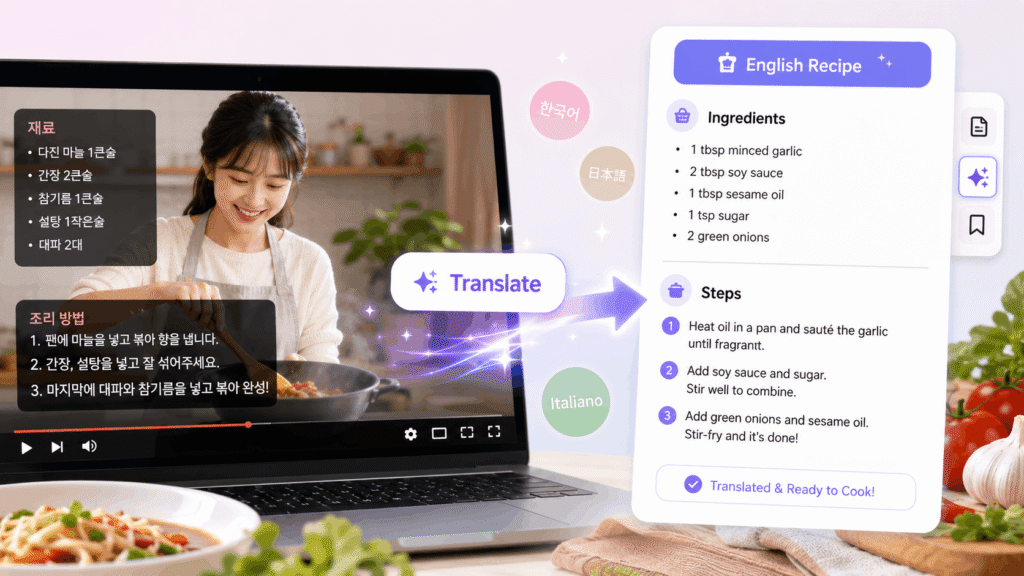
The better approach: extract and translate the recipe
The more reliable method is to extract the recipe from the video first — pulling out the ingredients and steps as structured text — and then translate that.
Structured text translates far better than live captions. There’s no timing pressure, no audio dropout, and the translator is working with complete sentences in a clear format rather than fragments racing past at video speed.
ChefScribe does this in one step. Paste the YouTube URL, and it reads the video audio, extracts the recipe, and outputs a translated English recipe card: ingredient list, quantities, and numbered steps, ready to cook from.
That means instead of squinting at subtitles while your onions go from golden to emotionally damaged, you have a clean written recipe in front of you before you even turn the hob on.
What the translated recipe card gives you
A good translated recipe card should be immediately cookable — no further detective work required. That means:
- Ingredient names in English, including common substitution notes where a local ingredient doesn’t have a direct equivalent (aubergine vs eggplant, coriander vs cilantro, double cream vs heavy cream)
- Quantities in a usable format — grams, millilitres, tablespoons, not vague spoken estimates
- Steps in the right order, as numbered instructions rather than embedded in conversation
- Cooking times and temperatures pulled out clearly rather than mentioned in passing

Once you have that, you can cook from the recipe card and watch the video alongside it for technique — how the dough should feel, what colour the sauce should be, when to know the fish is ready. The video and the recipe card do different jobs, and both are better for it.
A few things to double-check before you start cooking
Even with a good translation, it’s worth a quick check on a couple of things before you start:
Oven temperatures. Some creators use Celsius, some Fahrenheit. European videos almost always use Celsius. Worth confirming before you wonder why your cake isn’t browning.
Weight vs volume. A recipe from a country that measures by weight (most of Europe, Japan, Korea) may give quantities in grams where you’d expect cups or tablespoons. ChefScribe extracts what’s in the video, so if the original says 200g, that’s what you’ll get — which is actually more accurate anyway.
Ingredients without direct equivalents. Some regional ingredients genuinely don’t have a one-word English translation. If you see something unfamiliar, a quick search for the original-language name usually gets you there faster than guessing from a translation.
What you can do with the recipe once it’s in English
Once a foreign-language YouTube recipe exists as a translated English recipe card, the same options open up that apply to any ChefScribe recipe:
Save it to your library so you can find it again without hunting through your watch history. How to organise recipes you find on YouTube →
Print it out for a screen-free cooking experience. How to print a recipe from a YouTube video →
Check the nutrition breakdown — especially useful when you’re working with an unfamiliar dish and want to understand what kind of meal you’re making. Can you get nutrition info from a YouTube recipe? →
FAQ
Can YouTube automatically translate a recipe video into English?
YouTube can auto-translate captions, but the results are often unreliable for cooking — ingredient names mistranslate, quantities get lost, and steps get garbled. Extracting the recipe first and then translating structured text gives much better results.
What languages does ChefScribe work with?
ChefScribe can extract recipes from videos in a wide range of languages, including Korean, Japanese, Italian, Spanish, French, Mandarin, and others. The output is an English recipe card.
What if an ingredient in the translated recipe doesn’t exist where I live?
Search for the original-language name of the ingredient — you’ll usually find either the English equivalent or a common substitute. Some regional ingredients (specific chillies, fermented pastes, local greens) do require a bit of research, but that’s true of any authentic international recipe.
Does translating the recipe mean I don’t need to watch the video?
You still should, for technique. The recipe card tells you what to do and in what order. The video shows you what it should look like — texture, colour, consistency — which matters especially with unfamiliar dishes.
Final thoughts
Language barriers keep a lot of genuinely brilliant cooking out of reach. The best Italian pasta you’ve never made, the Korean stew that takes 20 minutes, the Japanese milk bread tutorial with 40 million views — most of that content is accessible if you can get the recipe into a format you can actually cook from.
The easiest way to translate a YouTube recipe into English is to start with the video transcript, then turn the translated instructions into a clean recipe card you can actually cook from.
Extracting and translating the recipe before you start is the step that makes it practical.
👉 Install ChefScribe free from the Chrome Web Store
Related guides: